The 2026 World Cup Is Changing the Card Rules. Here's Why It Matters.
FIFA has changed the card rules for 2026. A double yellow card amnesty, a red card for covering your mouth, and a red card for walking off the pitch.
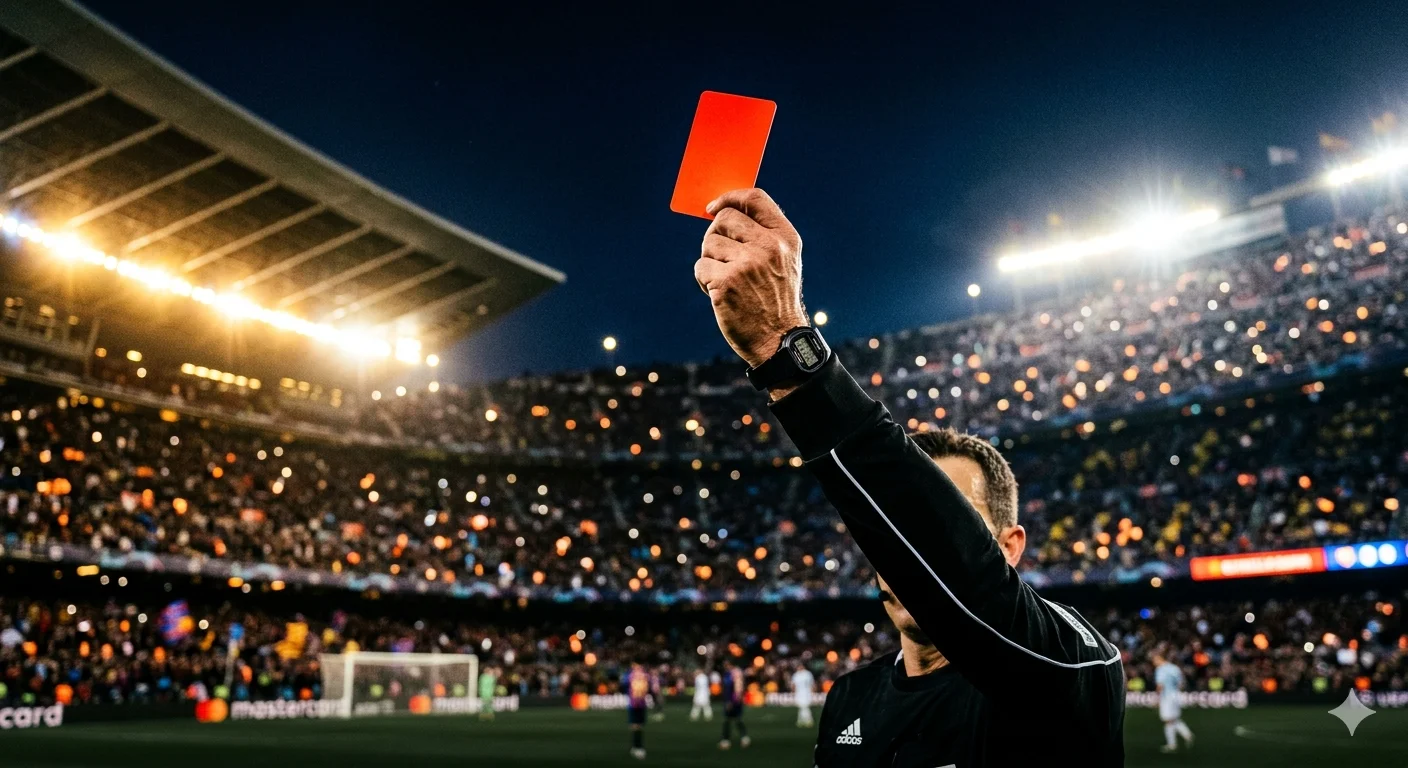
For as long as most football fans can remember, the disciplinary rules at a World Cup have been simple enough to explain in a sentence. Yellow cards accumulate. Two bookings means a one-game ban. Red cards are automatic suspensions. Everything resets after the quarterfinals.
That is still mostly true. But not entirely.
In the weeks before the 2026 World Cup kicks off in Mexico City, FIFA and the International Football Association Board have confirmed three significant changes to how cards will be handled this summer. One is a direct response to the expanded 48-team format. Two others are reactions to incidents that made headlines — and in one case, made football look genuinely ugly — in the months leading up to the tournament.
Taken together, they represent the most meaningful update to World Cup disciplinary rules in years. If you want to understand what referees will actually be empowered to do in North America this summer, you need to understand what has changed.
The yellow card problem nobody saw coming
To understand why FIFA changed the yellow card rules, you first need to understand what the expanded format broke.
In every World Cup from 1998 to 2022, yellow card bookings accumulated through the tournament and were wiped once — after the quarterfinals. It was a straightforward system. A player picking up a booking in the Round of 16 would need to avoid a second yellow in the quarterfinal, and if they managed that, they headed into the semifinal with a clean slate. Three knockout matches. One window of danger.
The jump to 48 teams and the introduction of a brand new Round of 32 changed the arithmetic entirely.
Under the old system applied to the new format, a player booked in the group stage would need to navigate the Round of 32, the Round of 16, and the quarterfinals — six matches in total — before their record was cleared. That is not a window of danger. That is a gauntlet. And it created a scenario where a midfielder picking up a perfectly routine yellow card in a group stage match against a minnow could find themselves suspended for a quarterfinal through the slow accumulation of pressure over six games.
FIFA recognised the problem. And at a meeting of the FIFA Council in Vancouver on 29 April 2026, they fixed it.
The double amnesty system, explained
The new system introduces two yellow card resets across the tournament rather than one.
The first amnesty arrives at the end of the group stage. When a team qualifies for the Round of 32, any player carrying a single yellow card from the group phase starts again with a clean record. They enter the knockout rounds unburdened.
The second amnesty arrives after the quarterfinals, exactly as it always has. Any player who picks up a single yellow during the Round of 32, the Round of 16, or the quarterfinals has that booking wiped before the semifinals.
What has not changed is the consequence of collecting two yellows. Two bookings still means a one-match ban, regardless of where in the tournament they are accumulated. And a red card still brings an automatic one-game suspension, as it always has. The amnesty is not a get-out-of-jail-free card. It is a recognition that the expanded format made the old system disproportionately punishing in a way nobody had intended.
In practical terms, what this means is that the window in which a single yellow card is dangerous has shrunk considerably. Rather than carrying a booking across six matches, a player now only needs to stay clean across three group-stage games or three knockout rounds before the slate is wiped. That is a much more manageable ask — and it makes it considerably more likely that the world's best players will still be available for the matches that matter most.
For fans, that last point is not a small thing. A World Cup without its stars at the business end of the tournament is a worse tournament. A system that made suspensions more likely through sheer accumulation rather than genuine misconduct was serving nobody.
The red card rules that nobody expected
If the yellow card changes were about fixing a structural problem, the two new red card rules are about something altogether different. They are about behaviour. And both of them were triggered by specific incidents that FIFA and IFAB decided they could not let pass without a response.
Both rules were approved by IFAB and confirmed by FIFA for enforcement at the 2026 World Cup.
Covering your mouth is now a red card offence
In February 2026, during a Champions League match, Benfica's Gianluca Prestianni was accused of directing racial abuse at Real Madrid's Vinícius Júnior. The allegation was serious. The problem was that Prestianni had covered his mouth with his jersey while speaking, making it impossible for officials to lip-read what was said or capture usable audio. UEFA ultimately handed him a six-match ban for verbal abuse, but could not confirm the specific nature of the insult — because the mouth covering had made evidence gathering effectively impossible.
FIFA president Gianni Infantino made his frustration with the situation clear. The covering of a mouth during a confrontation was, in his view, not ambiguous behaviour. It was a deliberate attempt to avoid accountability. And he pushed for a rule that would remove any incentive to try it.
From this summer, a referee has the power to issue a red card to any player who covers their mouth while speaking to an opponent in a confrontational situation. The logic is simple: if you have nothing to hide, you do not need to hide your face. If you do cover your mouth, a referee can treat it as evidence that you are saying something you know you should not be saying — and act accordingly.
It is worth being precise about what this rule is and is not. It is technically a competition opt-in rather than a change to the laws of football that applies to every game everywhere. IFAB has given competition organisers the power to enforce it; FIFA has chosen to exercise that power at the World Cup. You will not necessarily see it applied in your local Sunday league next season. But on the biggest stage in the sport, from June onwards, the gesture that Prestianni made in February will carry the risk of an immediate red card.
Walking off the pitch in protest is now a red card offence
The second new red card rule has a different origin. It comes from the Africa Cup of Nations final between Morocco and Senegal, in which Senegalese players walked off the pitch following a controversial penalty decision in added time. The scenes were chaotic, they were widely condemned, and they put football in a difficult position — there was no existing mechanism to punish a team that simply decided to leave the field of play in protest at a referee's call.
IFAB has now created one.
Referees at the 2026 World Cup will have the authority to issue a red card to any player who leaves the field as a form of protest against an official's decision. The intent is not to criminalise a player who drifts fractionally over the touchline. It is to give referees a tool that makes walking off the pitch — as a deliberate act of defiance — an immediately punishable offence rather than a chaotic situation that officials have no formal power to address.
As with the mouth-covering rule, FIFA has confirmed this will be enforced in North America this summer.
What all of this adds up to
Three changes. Three different problems being solved.
The double yellow card amnesty is about fairness — making sure that the structural demands of a bigger tournament do not result in the unintended punishment of players who have done nothing more than pick up a routine booking. The mouth-covering red card is about accountability — ensuring that players cannot use physical obstruction to escape the consequences of what they say on a football pitch. The walk-off red card is about order — giving referees the authority to keep twenty-two players on a field of play even when emotions are running high and a decision has gone against them.
None of these changes are happening in a vacuum. They reflect a FIFA that is acutely aware of how the 2026 World Cup will be watched, scrutinised and remembered. This is the biggest tournament in the history of the sport. Incidents that might pass with relatively limited consequence at a smaller competition will be magnified enormously in front of the largest audience ever to watch a football match.
Whether all three rules achieve what FIFA intends is a different question. Rules written in response to specific incidents do not always translate cleanly to the full range of situations referees will face in practice. The mouth-covering rule, in particular, requires a degree of subjective judgement — a player pulling their collar up against the cold looks different from a player deliberately shielding their lips during a confrontation, but not always different enough to be certain.
Referees will have to make those calls in real time, under pressure, in front of billions of people. That is not a comfortable position to be in.
But the intent behind the changes is hard to argue with. A World Cup where the best players are more likely to be available for the biggest matches. A World Cup where deliberate attempts to evade accountability carry meaningful consequences. A World Cup where a referee has the tools to keep a match moving forward rather than watching it unravel on the touchline.
The tournament starts on 11 June in Mexico City. By the time the Final is played on 19 July at MetLife Stadium in New Jersey, we will know whether these rules shaped the story of the tournament — or whether they sat quietly in the background, barely noticed.
Either way, you now know they are there.
Want to follow every match, track every booking, and build your own bracket for the 2026 World Cup? Head to CupRoute and see how far you think your team can go.
Share this article