World Cup Route 2026: Group Stage to Final Paths Explained
The FIFA World Cup 2026 route to the final runs through 104 matches across a new 48-team format: six group stages lead into a first-ever Round of 32, then Round of 16, quarter-finals, semi-finals, and the Final on 19 July 2026 at MetLife Stadium, New Jersey. Champions must win eight matches in total, one more than any previous World Cup winner.
What is the FIFA World Cup 2026 tournament format and how does the route system work?
The 2026 World Cup uses an expanded 48-team format across 12 groups of four, producing 104 matches in total. The top two teams from each group, plus the eight best third-placed teams, advance to a brand-new Round of 32, the first in World Cup history. From that point, it is a straight knockout competition through to the Final.
According to the FIFA Official Customer Support format guide, the champions will be required to win eight matches, one more than under the previous 32-team system. The bracket itself is pre-determined rather than drawn live. As JudgeMate's World Cup 2026 knockout bracket explainer details, each group position maps to a fixed slot, meaning the full picture locks the moment the final group match is played. There are 495 possible combinations for how the eight third-placed qualifiers are assigned, with the rule that no third-placed team can face a side from its own group.
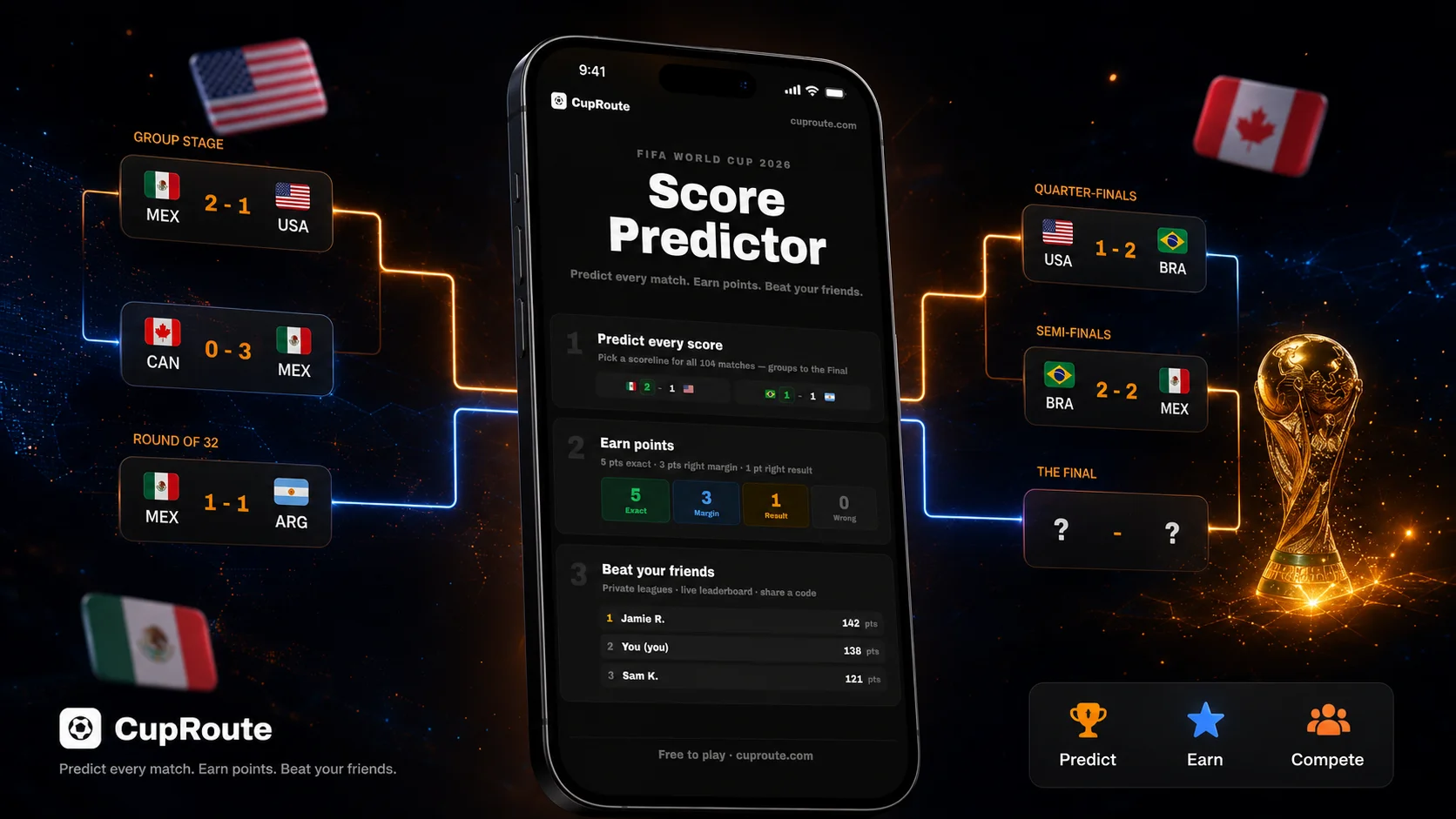
This structure makes tracking every team's potential route genuinely complex. CupRoute was built specifically for this: every one of the 104 fixtures is listed with automatic timezone conversion, so fans anywhere in the world can follow their team's route without manually adjusting for local time.
What are England's possible Round of 32 opponents and most likely Round of 16 matchups based on current standings?
England are in Group L alongside Croatia, Ghana, and Panama. Their Round of 32 opponents depend directly on where they finish in the group. As confirmed by England Football, group winners face a third-placed team from Groups E, H, I, J or K, currently projected as Senegal, while runners-up face the Group K runner-up, currently Portugal.
The implications of finishing first rather than second are therefore enormous. Sky Sports' World Cup 2026 bracket analysis notes that England benefit from FIFA's Wimbledon-style seeding system, meaning they cannot meet Spain or Argentina until the semi-finals, or France until the final, provided all four win their respective groups. A potential Round of 16 clash against Mexico in Mexico City and a possible quarter-final against Brazil on 11 July represent the kind of high-stakes route that makes early group performance so decisive.
England fans tracking this route can use CupRoute's team-specific fixture filter to view every potential England match in their local timezone and place score predictions across the full knockout path.
What are Brazil's potential World Cup 2026 route and knockout stage opponents?
Brazil won Group C convincingly, defeating Scotland and Haiti and finishing with a plus-six goal differential under Carlo Ancelotti. Their Round of 32 fixture is against Group F runners-up Japan in Houston on 29 June.
As ESPN's World Cup knockout rounds analysis sets out, Brazil's bracket position makes England a realistic quarter-final opponent under current projections. That would be one of the most anticipated fixtures of the tournament, should both sides navigate their respective Round of 32 and Round of 16 ties. Brazil's group-stage form suggests they arrive in the knockout rounds with momentum and a settled system, but the expanded format means five wins are still required before they lift the trophy.
Predicting Brazil's exact route is precisely the kind of challenge CupRoute's prediction game is built for. Fans can submit score predictions for every match across the bracket, not just their own national team's fixtures, and compete on a global leaderboard.
What is France's predicted path through Round of 32 and Round of 16 in World Cup 2026?
France topped Group I with maximum points and a plus-eight goal differential, the kind of dominant group stage performance that tends to signal genuine title ambition. Their Round of 32 opponents are Sweden, a manageable opener on paper.
The challenge intensifies sharply thereafter. ESPN's World Cup betting odds analysis projects France as tournament favourites at plus-400 odds, yet notes that a potential Round of 16 clash against Germany would rank among the most demanding knockout ties in the draw. The Netherlands are identified as a possible quarter-final opponent, meaning France's bracket is widely regarded as the toughest of any top contender despite their group stage dominance. That combination of favouritism and a brutal projected route makes France one of the most compelling teams to predict throughout the tournament.
How might Spain and Germany's World Cup routes compare based on group performance?
Spain and Germany have both secured their groups convincingly, yet their bracket positions lead them towards very different early knockout challenges. Spain won Group H by defeating Uruguay 1-0 and face the runners-up of Group J, currently either Austria or Algeria, in the Round of 32.
According to CBS Sports' World Cup bracket breakdown, Germany topped Group E and face Paraguay in the Round of 32 in Foxborough. Sky Sports and ESPN both flag France versus Germany as a potential Round of 16 blockbuster, a tie that would effectively serve as an early final between two of the tournament's strongest sides. Spain, listed as second favourites at plus-550 by ESPN, face a more navigable early path, with a realistic Portugal versus Spain Round of 16 scenario that FIFA's groups and qualification rules article helps contextualise through its tie-breaker framework. Spain's squad depth has been specifically highlighted as a decisive advantage in the expanded format.
What are the Netherlands' chances of advancing and who could they face in knockout rounds?
The Netherlands won Group F and face Morocco in the Round of 32 in Monterrey. Morocco qualified second from Group F, meaning this is a direct group-stage rematch in the first knockout round. The Netherlands enter as favourites but Morocco have already demonstrated they can compete at this level.
CBS Sports reports that betting odds on the Netherlands have shortened to 13-1 following their group stage performance, reflecting genuine belief that they can progress deep into the tournament. ESPN's bracket projections position them as a potential quarter-final opponent for France, which would represent one of the tournament's most anticipated ties. For neutrals and prediction league players alike, the Netherlands' route offers compelling match-by-match prediction opportunities at every stage.
CupRoute's private prediction leagues allow groups of friends to create their own competitions, set their own rules, and track each other's scores on a live leaderboard across all 104 matches, including every Netherlands fixture through to the Final.
Frequently Asked Questions
What is CupRoute and how does it work for World Cup 2026?
CupRoute is a FIFA World Cup 2026 fixture tracking and prediction platform. It shows all 104 matches in your local timezone, lets you predict the score of every group stage and knockout match, and allows you to compete in private or public prediction leagues with a live global leaderboard.
How many matches are there in the 2026 World Cup and what is the route to the final?
There are 104 matches in the 2026 World Cup. The tournament runs from the group stage through a new Round of 32, then Round of 16, quarter-finals, semi-finals, and the Final on 19 July 2026 at MetLife Stadium, New Jersey. The winning team must win eight matches in total, according to FIFA's official format guide.
How do I set up a private World Cup prediction league with my mates?
CupRoute lets you create a private prediction league, invite friends via a unique link, and compete across all 104 World Cup matches on a real-time leaderboard. It is a purpose-built alternative to setting up spreadsheets on Google Sheets or running informal competitions over WhatsApp or Discord.
How can I track World Cup 2026 matches in my local timezone?
CupRoute automatically converts every World Cup 2026 fixture to your local timezone, removing the need to manually calculate kick-off times across the North American host cities. You can also filter by team to see only your country's fixtures and route through the bracket.
Share this article