The 2026 World Cup Format Explained: Why This One is Different From Every Previous Tournament
48 teams, 104 matches, a brand new Round of 32, and the most complicated third-place rule in football history. Everything you need to know about how the 2026 World Cup actually works — and why it changes everything.
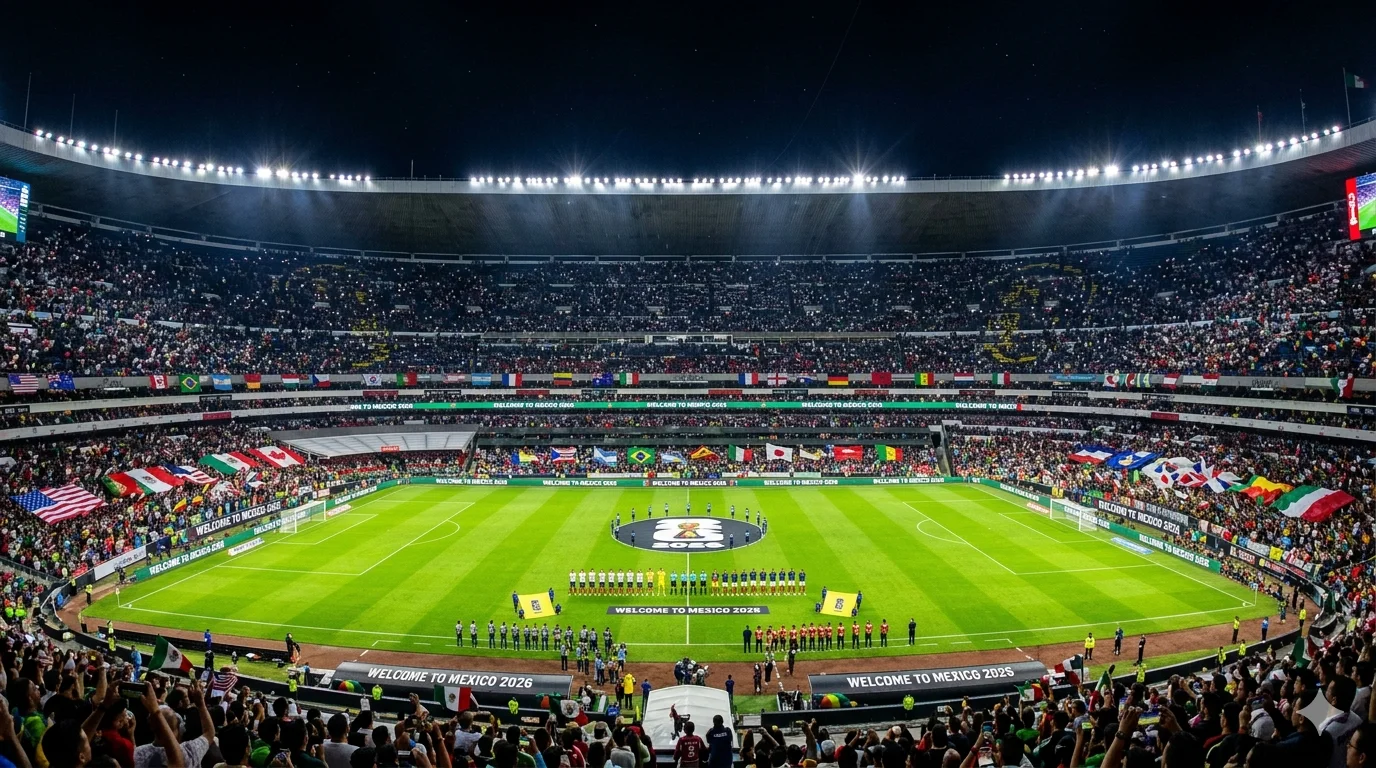
For the last 28 years, the World Cup has looked more or less the same. Thirty-two teams. Eight groups of four. Sixteen into the knockouts. A Route to the Final that every serious football fan could sketch on a napkin without thinking.
That changes in June 2026.
What is about to unfold across the United States, Canada and Mexico is not just the biggest World Cup ever held — it is a fundamentally different competition. One that will rewrite the tactical playbook for managers, create new mathematical nightmares for fans tracking advancement scenarios, and almost certainly produce storylines that the old format could never have generated.
If you want to understand what is coming, you need to understand the structure. So let's break it down — properly.
From 32 to 48: The biggest expansion in World Cup history
The World Cup has always grown. It started with 13 teams at the inaugural tournament in Uruguay in 1930, expanded to 16, then to 24 in 1982, and finally settled at 32 teams in France in 1998 — a format so well-liked that it ran, unchanged, for seven tournaments and nearly three decades.
The jump to 48 teams is not an incremental change. It is a 50 per cent increase in the field, adding 40 extra matches to the schedule and stretching the tournament from 32 days to 39. In total, 104 matches will be played across 16 host cities — more than any World Cup in history, by a significant distance.
FIFA voted for the expansion in January 2017. It was not universally popular. Critics worried about dilution of quality, the physical toll on players already exhausted by club football, and the death of genuine group stage drama. Defenders of the decision pointed to greater global representation, more nations from Africa, Asia and CONCACAF getting a genuine shot at the world's biggest stage, and the undeniable financial logic of more matches meaning more revenue.
The debate will continue. But the format is set. So here is how it works.
The group stage: 12 groups, same old format — mostly
The 48 qualified nations have been divided into 12 groups, labelled A through L, each containing four teams. In this respect, it is familiar territory: every team plays three group stage matches, one against each of their group opponents, in a round-robin format.
What changes is the sheer number of stories running simultaneously. In the old 32-team format, you had eight groups to track. Now there are twelve. Twelve "Groups of Death" to argue about. Twelve opening matches. Twelve final-day showdowns where everything is at stake.
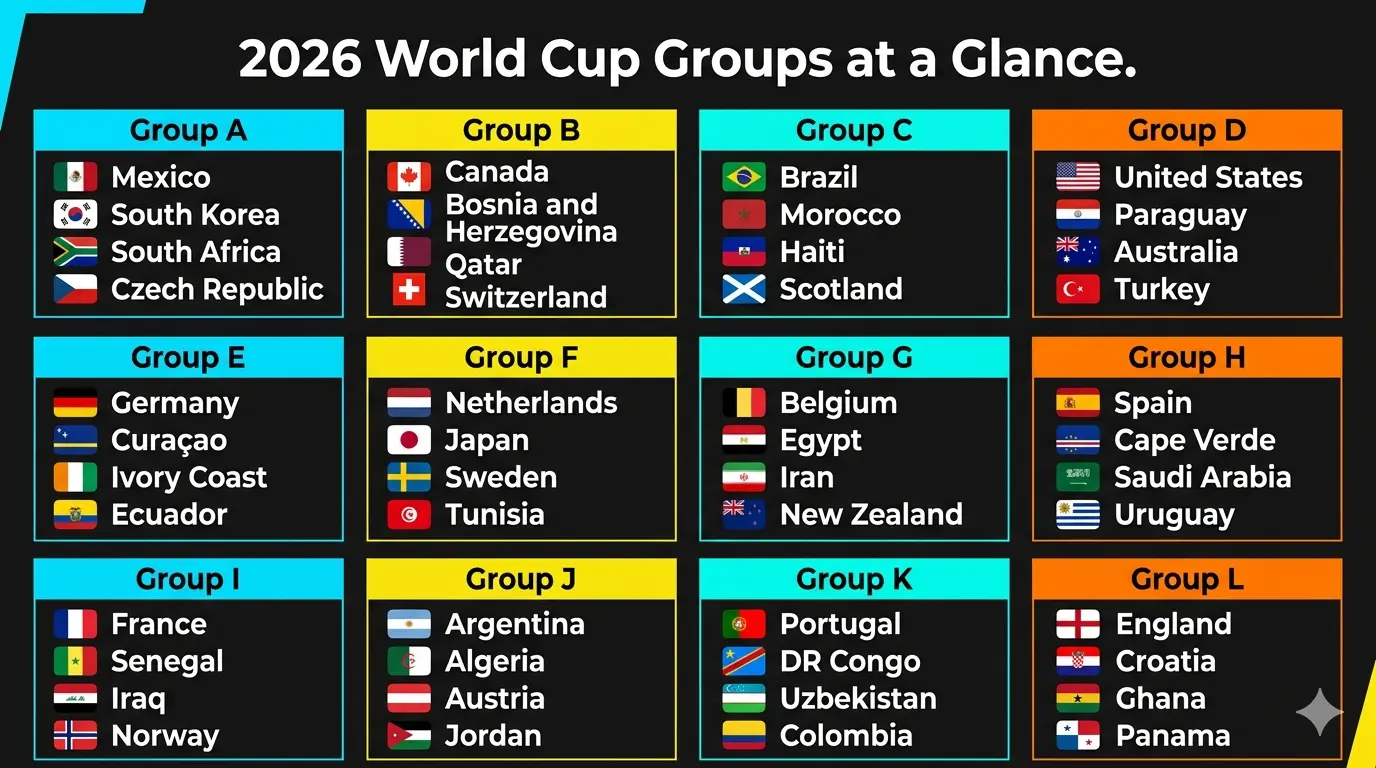
The 12 groups are as follows:
- Group A: Mexico, South Korea, South Africa, Czech Republic
- Group B: Canada, Bosnia and Herzegovina, Qatar, Switzerland
- Group C: Brazil, Morocco, Haiti, Scotland
- Group D: United States, Paraguay, Australia, Turkey
- Group E: Germany, Curaçao, Ivory Coast, Ecuador
- Group F: Netherlands, Japan, Sweden, Tunisia
- Group G: Belgium, Egypt, Iran, New Zealand
- Group H: Spain, Cape Verde, Saudi Arabia, Uruguay
- Group I: France, Senegal, Iraq, Norway
- Group J: Argentina, Algeria, Austria, Jordan
- Group K: Portugal, DR Congo, Uzbekistan, Colombia
- Group L: England, Croatia, Ghana, Panama
The part that confuses everyone: how teams actually qualify
This is where the 2026 format gets genuinely complex — and where even dedicated football fans have had to do a double-take.
In the previous 32-team format, qualification from the group stage was simple: finish first or second in your group, and you're through. Finish third or fourth, and you're out. Clean, brutal, easy to understand.
In 2026, it works like this:
- The top two teams from each of the 12 groups advance automatically. That is 24 teams.
- The eight best third-placed teams from across all 12 groups also advance.
- That gives you 32 teams heading into the knockout rounds.
Those final eight spots — the ones going to the best third-place finishers — are where things get complicated.
With 12 groups, there will be 12 third-placed teams when the group stage concludes. Only eight of them progress. To determine which eight, FIFA ranks all third-place finishers across every group using the following criteria, in order:
- Points
- Goal difference
- Goals scored
- Fair play record (yellow and red cards)
- FIFA world ranking
What this means in practice is that a team finishing third in their group does not know whether they have qualified until every other group has completed its final match. A team with four points and a goal difference of +3 might be safely through, or they might be agonisingly on the outside looking in — it depends on what twelve other teams did in eleven other groups.
For supporters, this creates an entirely new kind of final day. In the old format, if you were third in your group, you were simply going home. In 2026, you might be frantically tracking results from Monterrey, Toronto and Atlanta simultaneously, calculating whether your team's goal difference is enough to survive.
It is chaotic. It is stressful. It is, quite possibly, brilliant.
The Round of 32: the brand new knockout round nobody is used to yet
Once the group stage concludes, the tournament enters territory that no living player has ever experienced at a World Cup: the Round of 32.
This is a completely new round of knockout football. Sixteen matches, all single-elimination, played between 28 June and 3 July 2026. Lose, and you are out. It is the format fans know from the Round of 16 — but shifted one stage earlier and scaled up dramatically.
The bracket structure is partially predetermined. Group winners are drawn against third-place qualifiers or runners-up from other groups, but the exact matchups depend on which specific groups produced qualifying third-place teams. Because eight third-place teams advance from twelve groups and FIFA could not know in advance which eight those would be, they mapped out all 495 possible combinations before the tournament even began.
Yes. 495 possible bracket configurations. Welcome to 2026.
For teams that finished top of their groups, the Round of 32 is a tricky proposition. What used to be a relatively comfortable opening knockout match against a weaker opponent — typically a runner-up from a group you didn't play in — now involves an extra game that could be played against a dark horse nation that fought its way through an unexpectedly strong group. Depth matters more. Rotation will be essential. Injuries and suspensions that arrive in the group stage will carry greater weight.
The road to the final: longer than it has ever been
A team that reaches the 2026 World Cup Final will have played eight matches to get there. That is one more than the seven matches required under the previous format — and the extra game is not a gimme.
The full knockout journey looks like this:
| Round | Approximate dates | Teams remaining |
|---|---|---|
| Round of 32 | 28 June – 3 July | 32 |
| Round of 16 | 4–8 July | 16 |
| Quarter-finals | 9–11 July | 8 |
| Semi-finals | 15–16 July | 4 |
| Third place | 18 July | 2 |
| Final | 19 July | 2 |
The Final itself takes place on 19 July at MetLife Stadium in East Rutherford, New Jersey — the iconic venue just outside New York City that hosted Super Bowl XLVIII in 2014. It will be, by any reasonable measure, the largest audience ever to watch a single football match.
What the new format actually changes about the game
Beyond the structure, the 2026 format alters the strategic calculus of the tournament in ways that managers and analysts are only beginning to fully process.
Goal difference matters more than it ever has. When a team's group stage fate can hinge on whether twelve other third-place finishers across twelve groups scored more or fewer goals, the imperative to attack — even in "dead" matches where qualification is already secured — is greater than at any previous World Cup. Running up the score is no longer unsportsmanlike; it is rational strategy.
Winning your group is more valuable than ever. Finishing top means you face a runner-up or third-place qualifier in the Round of 32, rather than a group winner. Given the depth of talent in this expanded field, dropping points unnecessarily could mean the difference between facing, say, Turkey in the last 32 or stumbling into a match against a well-drilled dark horse who sneaked through with four points.
Squad depth is now a decisive factor. Eight matches to win a World Cup. Players who were fringe squad members at previous tournaments — the third goalkeeper, the fourth-choice striker — may now be pivotal figures in knockout matches.
The "Group of Death" conversation gets more interesting. With twelve groups instead of eight, you will always find one or two groups where three or four legitimate tournament contenders have been drawn together. But you will also find groups that, on paper, look far more open — and those groups could be where an unfancied nation quietly builds momentum for a deep run.
The critics are not entirely wrong
It would be dishonest to present all of this without acknowledging the legitimate concerns.
More teams inevitably means some group stage matches that look competitive on paper but unfold as comfortable victories for the stronger side. Not every one of the 104 matches in this tournament will be a classic. Some nations are participating primarily because FIFA wanted them there, and the gap in quality will occasionally show.
There is also the player welfare question. The 2025-26 club season is already one of the most demanding in football history, with expanded European competitions adding fixtures to already congested calendars. Players will arrive at this World Cup with miles on the clock. An eight-match run to the final, in North American summer heat, is a serious physical undertaking.
And the collusion concern — the reason FIFA initially considered using groups of three teams before backing away — has not entirely disappeared. In theory, two teams who have already secured qualification could play out a mutually beneficial draw in their final group match that serves neither competitively. It happened infamously in 1982. The four-team groups make it harder but not impossible.
The format is not perfect. No format ever is.
So: is this the greatest World Cup ever?
The honest answer is that nobody knows yet. Bigger is not automatically better. More matches is not automatically more drama. But the 2026 World Cup has the ingredients — a record field, three host nations, iconic cities, generational players in the final chapters of their careers, and a structural shake-up that guarantees nobody will be watching with total comfort.
The teams who understand the new format best — who plan their group stage strategy around goal difference, who manage their squads across a potential eight-game run, who know exactly what bracket scenario they are targeting — will have a genuine edge over those who approach 2026 like any other tournament.
For fans, the work is the same. Watch, follow, care. But this time, keep a close eye on twelve groups simultaneously, and do not assume anything is settled until the final whistle blows on matchday three — in all twelve groups.
It is the biggest World Cup in history. Whether it becomes the best one starts on 11 June in Mexico City.
Want to build your own 2026 World Cup bracket and predict how it all plays out? Try the CupRoute bracket predictor and see who you think lifts the trophy in New Jersey.
Share this article