All 48 Teams at the 2026 World Cup: Every Nation Listed by Group
The 2026 World Cup features 48 nations across 12 groups — the biggest field in the tournament's history. Every team, every group, all in one place.
Quick Answer
The 2026 World Cup features 48 teams split into 12 groups of four. The field includes sides from all six confederations, with the biggest representation ever from Africa (10 teams), Asia (9 teams) and CONCACAF (6 teams). Four nations — Cabo Verde, Curaçao, Jordan and Uzbekistan — are making their World Cup debut.
How many teams are in the 2026 World Cup?
For the first time in the tournament's history, 48 nations will compete at the World Cup. This is an increase of 16 teams from the 32-team format that ran from 1998 to 2022 — a 50 per cent expansion that also means 104 matches, 39 days of football, and an entirely new knockout round called the Round of 32.
The 48 teams were confirmed following the completion of FIFA's global qualifying process, with the final six spots decided in inter-confederation play-off matches in March 2026. The full draw took place at the Kennedy Center in Washington D.C. on 5 December 2025.
Which teams are in the 2026 World Cup?
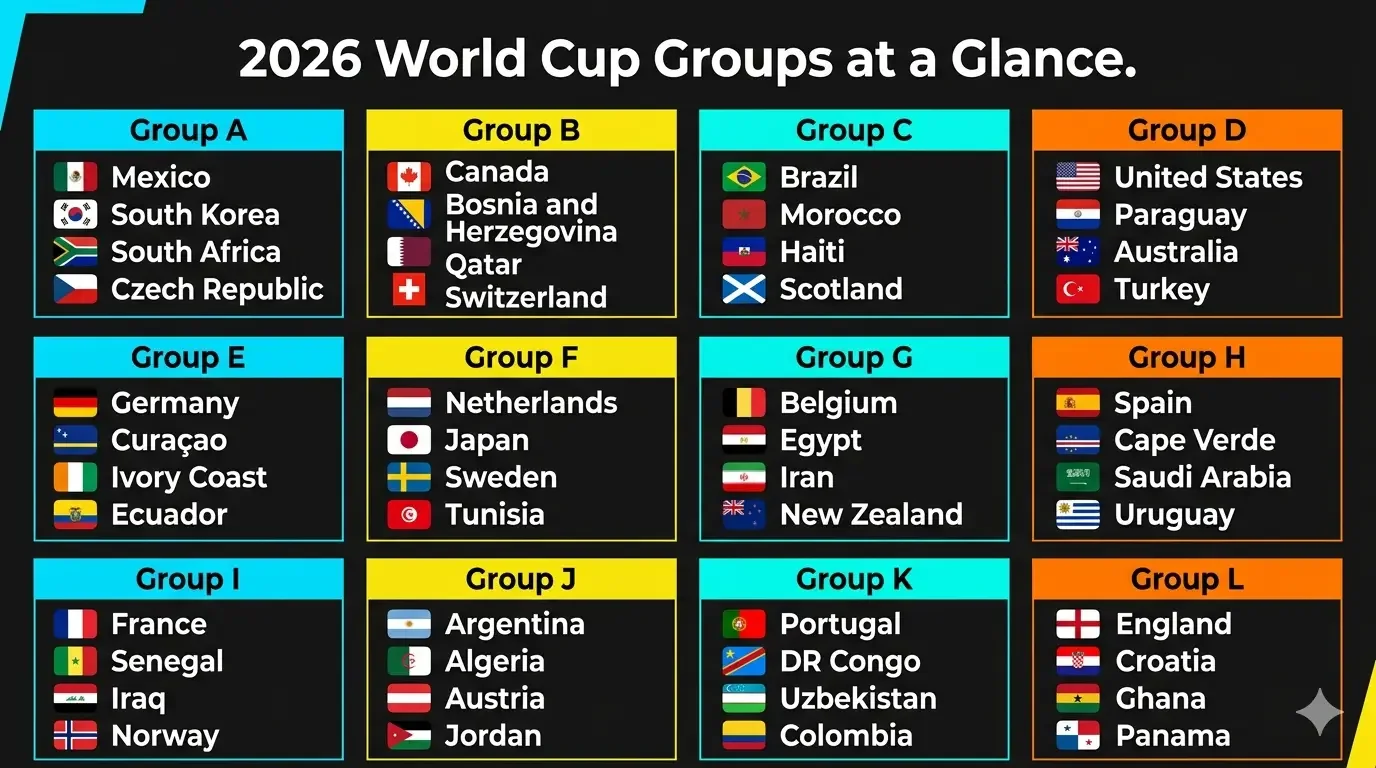
All 48 qualified nations are listed below, organised by group.
Group A Mexico, South Korea, South Africa, Czechia
Group B Canada, Bosnia and Herzegovina, Qatar, Switzerland
Group C Brazil, Morocco, Haiti, Scotland
Group D United States, Paraguay, Australia, Türkiye
Group E Germany, Curaçao, Côte d'Ivoire, Ecuador
Group F Netherlands, Japan, Sweden, Tunisia
Group G Belgium, Egypt, Iran, New Zealand
Group H Spain, Cabo Verde, Saudi Arabia, Uruguay
Group I France, Senegal, Iraq, Norway
Group J Argentina, Algeria, Austria, Jordan
Group K Portugal, DR Congo, Uzbekistan, Colombia
Group L England, Croatia, Ghana, Panama
Which teams are making their World Cup debut in 2026?
Four nations are appearing at the World Cup for the first time.
Cabo Verde — the Atlantic island nation qualified from Africa and are the smallest country by population in the tournament. They are in Group H alongside Spain, Saudi Arabia and Uruguay.
Curaçao — the Dutch Caribbean island nation qualified through CONCACAF. They are in Group E alongside Germany, Côte d'Ivoire and Ecuador — a brutal group for a debut side.
Jordan — qualified through the AFC pathway. They are in Group J alongside Argentina, Algeria and Austria.
Uzbekistan — qualified from the AFC and are in Group K alongside Portugal, Colombia and DR Congo.
Which confederations have the most teams at the 2026 World Cup?
The expanded format has dramatically increased representation from confederations that were historically underrepresented at previous World Cups.
UEFA (Europe) leads with 16 teams, as it has done at previous tournaments. CAF (Africa) has its biggest-ever allocation with 9 teams. AFC (Asia) has 8 teams. CONMEBOL (South America) has 6 teams. CONCACAF (North and Central America and Caribbean) has 6 teams, including the three host nations. OFC (Oceania) has 1 team — New Zealand — making their first World Cup appearance since 2010.
The increased African and Asian representation was a key driver behind FIFA's decision to expand the tournament. Critics of the expansion argued it would dilute quality; defenders pointed to the greater global reach it creates.
Who are the host nations at the 2026 World Cup?
The 2026 World Cup is hosted jointly by three nations: the United States, Canada and Mexico. It is the first World Cup to be hosted by three countries simultaneously, and the first hosted in North America since the United States hosted the 1994 edition.
All three host nations received automatic qualification. Mexico are in Group A, Canada in Group B and the United States in Group D.
Mexico is particularly notable: this is their third time hosting or co-hosting the men's World Cup (having previously hosted in 1970 and 1986), making them the only nation to have done so three times.
Which teams are the favourites to win the 2026 World Cup?
Argentina enter as defending champions, having lifted the trophy at Qatar 2022 under Lionel Messi. They are in Group J alongside Algeria, Austria and Jordan.
France, Spain, Brazil, England, Germany and Portugal are all considered serious contenders. The expanded field gives more room for dark horses — particularly sides from Africa and Asia who now have larger allocations and stronger pathways through the group stage.
The 2026 format also adds an extra game to the route to the final — eight matches rather than seven — which places a greater premium on squad depth than any previous tournament. Teams that can rotate effectively without losing quality will have a genuine advantage.
How does qualification work at the 2026 World Cup?
Every team plays three group stage matches — one against each of their group opponents. The top two teams from each of the 12 groups advance automatically to the knockout rounds. That produces 24 qualified teams.
The remaining eight knockout spots go to the best third-place finishers across all twelve groups. FIFA ranks all twelve third-place teams using points, goal difference, goals scored, fair play record and FIFA ranking. The top eight third-placed teams advance.
This means the group stage produces 32 knockout teams — the same number as the entire tournament field under the old 32-team format. Those 32 teams then compete in the Round of 32, followed by the Round of 16, quarter-finals, semi-finals and the Final.
Which 2026 World Cup teams are playing their last tournament with a legendary player?
The 2026 tournament is likely to be the last World Cup for several of the sport's most iconic figures.
Lionel Messi (Argentina) will be 38 during the tournament and has strongly suggested this will be his final World Cup. Cristiano Ronaldo (Portugal) turns 41 in February 2026, making this almost certainly his last appearance on the world stage. Luka Modrić (Croatia) is 40 and a central figure in his nation's Group L campaign. Neymar (Brazil) — if selected and fit — would be 34.
For neutral fans, the chance to watch these players in a World Cup setting — potentially for the last time — adds a layer of emotional stakes to the 2026 tournament that transcends the results on the pitch.
Want to track every team's progress, build your own bracket and predict the winner? Head to CupRoute and start planning your World Cup.
Share this article